Transform Phonics Instruction with the Phonics BINGO Game for K–5th Grade
Bringing Phonics to Life Through Interactive Play
Phonics instruction is most effective when students are actively engaged and motivated to participate. Traditional drills and flashcards often fall short in capturing young learners' attention, especially in mixed-grade classrooms where reading abilities vary widely. The Phonics BINGO Game for K–5th Grade addresses this challenge by transforming foundational literacy practice into an interactive, collaborative, and enjoyable experience.
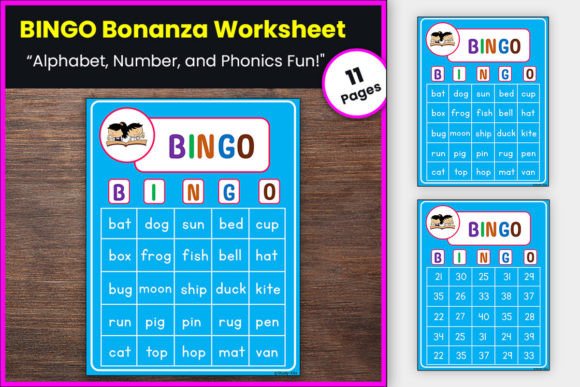
Designed with flexibility in mind, this BINGO set includes 11 uniquely structured game cards that cater to a wide range of phonics skills—from basic letter sounds in kindergarten to more complex phonograms and word families in upper elementary grades. Its adaptability makes it an ideal tool for educators working with diverse learners across multiple grade levels, including differentiated instruction settings and multi-age classrooms.
How the Game Supports Phonics Development
At its core, the Phonics BINGO Game for K–5th Grade reinforces essential phonics components such as:
- Letter-sound correspondence
- Blending and segmenting sounds
- Recognizing common phonics patterns
- Identifying short and long vowel sounds
- Decoding real and nonsense words
Each game card is carefully curated to reflect age-appropriate phonics elements. For example, younger students might match initial consonant sounds, while older students may focus on digraphs, diphthongs, or inflectional endings. This tiered design ensures that all learners remain challenged and engaged regardless of their current reading level.
Flexible Implementation for Diverse Learning Environments
One of the standout features of this phonics BINGO set is its versatility in instructional settings. Whether used in whole-class instruction, small-group intervention, or as a literacy center activity, the game adapts seamlessly to different teaching contexts. Here are a few ways educators can incorporate it into their phonics instruction:
- Whole-Class Warm-Up: Begin reading lessons with a quick round of BINGO to activate prior knowledge and set a positive tone for learning.
- Guided Reading Support: Use the game during small-group sessions to reinforce specific phonics patterns being taught in the lesson.
- Independent Literacy Centers: Set up the game as a self-directed station where students can practice phonics skills with minimal supervision.
- Homework Extension: Send home printable BINGO cards and a list of possible phonics prompts for family engagement and reinforcement.
Because the game allows for multiple variations in play—such as horizontal lines, vertical columns, or full card coverage—students remain engaged over repeated uses. Teachers can also adjust the difficulty by varying the types of phonics prompts, from simple sounds to more complex word structures.
Interactive Learning That Encourages Participation
Active participation is a cornerstone of effective phonics instruction. The Engaging Phonics BINGO Game for All Grades promotes this by turning passive listening into an interactive experience. When a phonics sound or word is called, students must quickly identify and locate the corresponding element on their cards. This process strengthens auditory discrimination, visual recognition, and quick recall—skills critical for early reading success.
Moreover, the competitive yet low-stakes nature of BINGO encourages peer interaction and collaborative learning. Students often help each other identify sounds and celebrate each other’s wins, fostering a positive classroom culture around literacy development.
Design and Usability Features
The Phonics BINGO Game for K–5th Grade is designed with both educators and students in mind. The set is delivered as a high-quality, print-ready PDF file, formatted to standard 8.5 x 11-inch page dimensions, ensuring compatibility with most printers and laminators. The 11-page set includes:
- Multiple BINGO card templates with varying phonics elements
- A master call sheet for the teacher to track called sounds and words
- Instructions for gameplay variations and classroom integration
Each card is carefully laid out with clear, legible fonts and ample spacing to reduce visual clutter—especially important for younger readers or students with visual processing challenges. The inclusion of bleed settings ensures professional-quality printing without cutting off important design elements.
Adapting the Game for Different Grade Levels
One of the most valuable aspects of this resource is its cross-grade applicability. Here’s how it can be tailored to suit various grade levels:
- Kindergarten: Focus on letter sounds, rhyming words, and CVC (consonant-vowel-consonant) words.
- First Grade: Introduce short vowels, blends, and simple digraphs like “sh” and “ch.”
- Second Grade: Reinforce long vowels, diphthongs, and vowel teams like “ai” or “ee.”
- Third Grade and Beyond: Extend learning to include inflectional endings, suffixes, and more complex phonograms.
By adjusting the phonics prompts and encouraging students to read the words aloud, teachers can easily scale the game to meet evolving literacy standards and student needs.
Why Phonics BINGO Works Better Than Traditional Drills
While flashcards and worksheets have their place in phonics instruction, they often lack the engagement necessary to maintain students’ attention. In contrast, the Engaging Phonics BINGO Game for All Grades combines repetition with fun, encouraging students to practice phonics skills without feeling like they’re doing “drill work.”
Research supports the idea that game-based learning increases retention and motivation. By incorporating elements of competition, surprise, and immediate feedback, BINGO helps students build automaticity in phonics recognition—a key predictor of reading fluency.
Real-World Application in the Classroom
Many educators have reported success using the Phonics BINGO Game for K–5th Grade in varied instructional contexts. For instance, one second-grade teacher noted that students who previously struggled with vowel teams became more confident after playing the game several times a week. Another educator in a multi-age classroom found that the game helped bridge skill gaps between kindergarten and first-grade students during literacy stations.
Additionally, the game supports English Language Learners (ELLs) by reinforcing phonological awareness and vocabulary development in a non-threatening, interactive format. Since students are not required to read full sentences but instead match sounds or word parts, the barrier to entry is low, making it accessible for a wide range of learners.
Conclusion
Incorporating the Phonics BINGO Game for K–5th Grade into daily literacy instruction can transform the way students engage with phonics. By blending educational content with the excitement of a classic game format, this resource offers a powerful tool for educators seeking to enhance phonics instruction across grade levels. Whether used for whole-class instruction, small-group reinforcement, or independent practice, the game provides a flexible, scalable, and enjoyable way to build essential reading skills.